
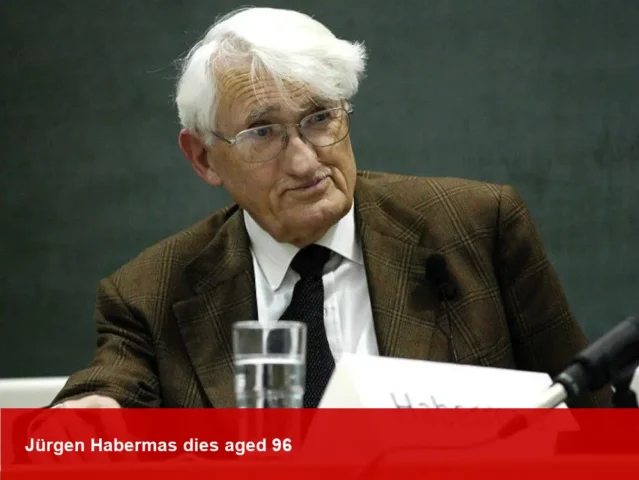
Jürgen Habermas, the influential German philosopher and leading figure of the post‑Marxist Frankfurt School, has died aged 96. He was renowned for his theory of political consensus‑building and for arguing that Jewish and Christian thought had helped shape the moral universalism that underpins democratic egalitarian societies.
Career and ideas
Habermas built a career as a prominent critical theorist whose work focused on the conditions for democratic discourse and consensus. Though associated with the second wave of the Frankfurt School and with post‑Marxist critical theory, his influence cut across political lines.
He argued that religious traditions had contributed to the emergence of modern egalitarian values. In a 1999 interview, “A Conversation About God and the World,” published in his book Time of Transitions, he wrote:
“Egalitarian universalism, from which sprang the ideas of freedom and social solidarity, of an autonomous conduct of life and emancipation, of the individual morality of conscience, human rights and democracy, is the direct heir of the Judaic ethic of justice and the Christian ethic of love. This legacy, substantially unchanged, has been the object of continual critical appropriation and reinterpretation. To this day, there is no alternative to it. And in light of the current challenges of a postnational constellation, we continue to draw on the substance of this heritage. Everything else is just idle postmodern talk.”
Dialogue with the church and public exchange
Habermas engaged publicly with figures across the intellectual and religious spectrum. In 2004 he exchanged ideas with Cardinal Joseph Ratzinger, the future Pope Benedict XVI. Habermas wrote: “The starting point for the philosophical discourse about reason and revelation is a recurrent idea: namely, that when reason reflects on its deepest foundations, it discovers that it owes its origin to something else.”
Ratzinger’s reply stressed mutual responsibility between faith and reason in contemporary society, writing that the Christian faith and Western secular rationality “must learn to listen and to accept a genuine relatedness to these other cultures, too.”
Reactions and legacy
News outlets noted Habermas’s wide influence. The Guardian observed that, “In spite of his background in the neo‑Marxist Frankfurt school and his reputation as a court philosopher of the Social Democratic party, his influence cut across party lines.”
German chancellor Friedrich Merz described him as “one of the most significant thinkers of our time,” adding: “His analytical acuity shaped democratic discourse far beyond our country’s borders and served as a beacon in a stormy sea. His voice will be missed.”
Habermas leaves behind a body of work that shaped debates about democracy, ethics and the role of religion in public life. Further details about his death have not been specified in reports released so far.
Image Referance: https://anglican.ink/2026/03/19/jurgen-habermas-critical-thinker-who-could-see-christianitys-imprint-on-the-west-dead-at-96/