
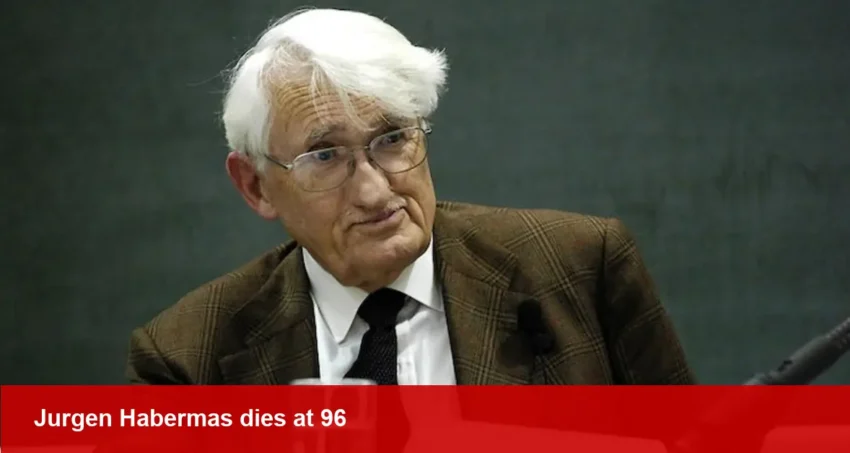
Jurgen Habermas, the German philosopher and former leader of the Frankfurt School of critical theory, died on Saturday. He was 96. Habermas was widely known for his commitment to public debate and for taking public positions on contentious issues, including a defense of Israel’s right of self‑defense.
Career and intellectual commitments
Habermas rose to prominence as one of the most influential figures in modern social theory. Described in the source text as a “super‑famous philosopher,” he was identified with the Frankfurt School and with a style of social thought that emphasized deliberation in the public square. His work argued that societal problems could and should be addressed through open engagement and reasoned debate, a theme repeated throughout his public interventions and writings.
His approach placed him at odds with parts of the academic left in later years. The article notes that Habermas resisted a turn toward what he saw as postmodern relativism and championed the existence of facts discoverable through honest debate. His biographer summarized this stance by telling the New York Times: “He was a rationalist when it was unfashionable to be one.”
Last months, public letters and reactions
In November 2023, Habermas and three co‑authors published an open letter addressing the October 7 attacks and the subsequent fighting, arguing in part that while retaliation could be justified in principle, principles of proportionality and the prevention of civilian casualties must guide conduct. The letter included the following passage:
“The Hamas massacre with the declared intention of eliminating Jewish life in general has prompted Israel to strike back. How this retaliation, which is justified in principle, is carried out is the subject of controversial debate; principles of proportionality, the prevention of civilian casualties and the waging of a war with the prospect of future peace must be the guiding principles. Despite all the concern for the fate of the Palestinian population, however, the standards of judgement slip completely when genocidal intentions are attributed to Israel’s actions.”
The piece describes how Habermas’s defense of Israel’s right of self‑defense drew sharp criticism from some fellow intellectuals. Responding authors — named in the source article as Adam Tooze and Samuel Moyn among others — published their own open letter questioning whether Habermas’s concerns had been extended to Palestinian civilians and to Muslims in Germany facing rising Islamophobia. The original source characterizes the exchange as illustrative of a larger debate over the application of human‑dignity principles and the role of facts in public argument.
Commenting on Habermas’s public stance and methodology, the article emphasizes that he remained committed to reasoned debate and to the idea that truth could be pursued through engagement rather than consensus‑making or groupthink. The source describes his refusal to join what it calls a “manufactured consensus” as a defining feature of his final public interventions.
Legacy
Jurgen Habermas’s career is presented in the source material as one marked by a sustained belief in public reasoning and human dignity. In his later years he continued to provoke debate and to take clear public positions on fraught political questions. The article closes by noting that the truth Habermas sought through open debate, as reported in the source material, will endure as part of his intellectual legacy.
Image Referance: https://www.commentary.org/seth-mandel/what-jurgen-habermas-knew/